I believe in Christianity as I believe that the Sun has risen, not only because I see it but
because by it I see everything else …
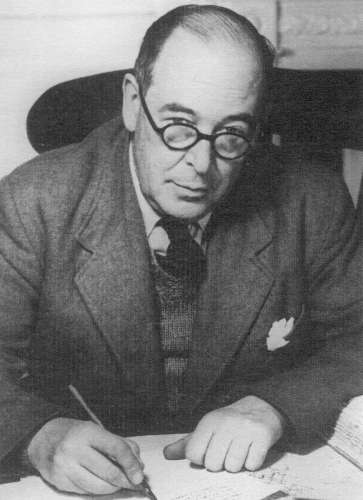
C.S Lewis
Quick Facts
Full Name: Clive Staples Lewis
Born: November 29, 1898
Died: November 22, 1963 (aged 64)
Work: Writer, Apologist, Poet, Scholar
Most Popular Works: The Chronicles of Narnia, The Screwtape Letters.

Known by friends and family as Jack (a self given name he adopted up after his dog
Jacksie was killed by a car). You could say he was a man born before his time in many
ways or rather still a man who launched the world to new times by his rich imagination
and rigid faith.
Born in Belfast, Ireland (present day Northern Ireland) into the well positioned family of
Albert and Florence Lewis. As a young lad, his imagination ran free with a particular
fascination of anthropomorphic animals, he and his brother Warnie soon created the
world of Boxen, populated and driven by talking animals. His appetite to read was
stirred and well watered by his parents who stocked the house full of books, his dad
being a solicitor and his mom a graduate of the Royal University of Ireland (a fit quite
rare for women in those days). Lewis himself being a bit prodigy himself was reading by
age three and by five had begun writing stories, he fed extensively and voraciously on
those books, he writes in his autobiography, Suprised by Joy “endless books… There
were books in the study, books in the dinning room, books in the cloakroom, books (two
deep) in the great bookcase on the landing, books in a bedroom, books piled as high as
my shoulder in the cistern attic, books of all kinds” and none was off limits to him.
Life took a not so pleasant turn when his brother Warnie was sent off to boarding
school in England, leaving the young Lewis alone, he became somewhat reclusive,
spending more and more time in books and his imaginary world of dressed animal and
knights in armor. Things went even more sour when he turned 10 and his mother died
of Cancer, he became even more driven into himself and his books, his father never
really fully recovered and this led both boys to feel even more estranged from their
dad. His mom’s death planted a seed of doubt in God, he reasoned that God, if not
cruel, was at least a vague abstraction. About five years down that line around 1912 (in
the tender teen age of 15) and with the additional influence of his boarding school
(where his father had now enrolled him) and, Lewis abandoned the Christian faith and
became an avowed atheist, he later described his young self as being paradoxically
“angry with God for not existing”.
By September of 1914 Lewis was sent to Great Bookham, Surrey, to be privately tutored
by W.T. Kirkpatrick, this man had a tremendous effect upon the young Lewis, he
introduced him to classics in Greek, Latin and Italian literature. Being a tutor that must
see result he helped Lewis learn how to criticize and analyze, taught him how to think,
speak and write logically. After nearly three years with Kirkpatrick Lewis had grown in
bounds and leaps in his literary academic prowess, this showed in his success in the
scholarship examinations at Oxford and later in his outstanding performance at
University College, grabbing highest honours in honour moderations, greats and
English. His hardpressing mentor also helped him reinforce his atheistic beliefs, but his
admission to Oxford and the associates he would soon make would cause the budding
Lewis to rethink his God-void universe.
He entered the world of Oxford in 1917 and in a sense he never left, despite the call to
fight in World war 1 and his professorship later in life at Cambridge, he always
maintained his home and friends in Oxford. During World war 1 he and his college
roommate Paddy Moore, made promises to each other, that if either of them should
die in the war, the other would take care of the deceased’s family. Paddy Moore died,
Lewis kept his word and took care of Paddy’s mother, after completing his first degree
in 1920, Lewis decided to share the same lodging with Paddy Moore’s family so that he
could more carefully look out for their needs, this kind gesture got Lewis outside of
himself and taught him patience. Soon the books The everlasting man by G.K.
Chesterton and Phantastes by George MacDonald began to dig through his stony
atheistic heart, he would later write of the book Phantastes “what it actually did to me
was to convert, even baptize…my imagination”
The years went on but distress in the stony heart of Lewis only kept increasing, friends
from his student and post student life like Owen Barfield and Nevill Coghill often
pounced on the logic of Lewis’ atheism. He would later meet two more Christians with
whom he became close friends; J.R.R Tokien (author, Lord of the Rings) and Hugo
Dyson. Eventually the two paths converged in Lewis’ mind: one was reason and the
other intuition, he vigorously resisted conversion, noting that he was brought back into
Christianity like a prodigal, “kicking, struggling, resentful, and darting his eyes in every
direction for a chance to escape”. He painted his final struggle to come to God in his
book Suprised by Joy, “You must picture me alone in that room in Magdalen[College,
Oxford], night after night, feeling, whenever my mind lifted even for a second from my
work, the steady, unrelenting approach of Him whom I so earnestly desired not to meet.
That which I greatly feared had at last come upon me. In the Trinity term of 1929 I gave
in, and admitted that God was God, and knelt and prayed: perhaps, that night, the
most dejected and reluctant convert in all England”
After his conversion to Theism in 1929, Lewis converted to Christianity in 1931, after a
lengthy talk and late night walk with his close friends Tokien and Hugo Dyson. He
became a firm member of the Church of England -somewhat to the disappointment of
Tolkien, who had hoped he would join the Catholic church.
The second world war, proved to be a set time for C.S. Lewis, he spoken on radio from
1941 to 1943 by the BBC while the city was under periodic air raids, these broadcasts
were widely received and ministered greatly to the people, also increasing the
popularity of Lewis. After the war in 1951 he declined a honour by George VI as
Commander of the Order of the British Empire (CBE) in order to avoid association with
political issues.
It is interesting to note that with the increase of Lewis fame came other pressures,
numerous invitations to entertain guests, grant interviews, give lectures and preach
sermons. And even though he felt called by God to write, he likewise felt it was
required of him to counsel all those who came all the way to his home. As his books
became popular he was flooded by letters, and because he believed that it was Gods
will for him to answer most of this mail himself stating that there were “no ordinary
people” he took his time to write with care to each correspondent regardless of age,
education, or place in society, needless to say this consumed many hours each week.
Joy entered his life in 1956, literally. Joy Davidman, an American writer also a convert
from Atheism to Christianity became Mrs Lewis. She and her two teenaged kids
changed C.S. Lewis’ life for the better. His happiness can be seen in a note he wrote to a
friend soon after they got married “it’s funny having at 59 the sort of happiness most
men have in their twenties… ‘Thou hast kept the good wine till now’.” She brought him
love, companionship and tow stepson with all its accompanying drama, she also
encouraged him to renew his writing of apologetics. Unfortunately his Joy was short
lived as she died of Cancer 4 years into their most blissful marriage. Lewis was quite
devastated by this loss and describes his experience of bereavement in his book A Grief
Observed, he expressed his feelings in such a raw and personal manner that he
originally released it under the pseudonym N. W Clerk to keep readers from associating
the book with him. Funny enough, many friends recommended the book to Lewis as a
method of dealing with his own grief.

C.S. Lewis was a reputed Scholar, prolific writer and noted Novelist who infused Biblical
themes in his story lines, his novel, The Pilgrim’s Regress following John Bunyan’s style
in The Pilgrims Progress was the first of Christian publications he would make and more
were sure to follow. The Chronicles of Narnia in particular, which has been adopted
both into feature films and programs carries the biblical theme of Christ (Aslan in this
case) who basically gives his life for the salvation of those He loves and comes back to
life again. His book, Mere Christianity was voted best book of the twentieth century by
Christianity Today in 2000, he has been called “The Apostle to the Skeptics” due to his
approach to faith, presenting a reasonable case for Christianity, other books in this class
include, The Problem of Pain and Miracles. In 2008 he was ranked by The Times as the
eleventh on their list of “the 50 greatest British writers since 1945”
Lewis died at the Kilns on November 22, 1963, buried beside his brother who passed on
10 years later, he authored more than 70 titles, including works of science fiction,
fantasy, poetry, letters, autobiography and Christian apologetics, Lewis’ book sales are
reported to be more than 2 million annually.
References
http://www.britannica.com/biography/c-s-lewis
http://www.biography.com/.amp/people/cs-lewis-9380969
http://www.explorefaith.org/lewis/bio.html
http://www.wikipedia.com/wiki/c._s._lewis
http://www.christianitytoday.com/history/issues//issue-7/cs-lewis-profile-of-hislife.
html#storystream
http://www.cslewis.org/resource/chronocsl/







 Christ a poet