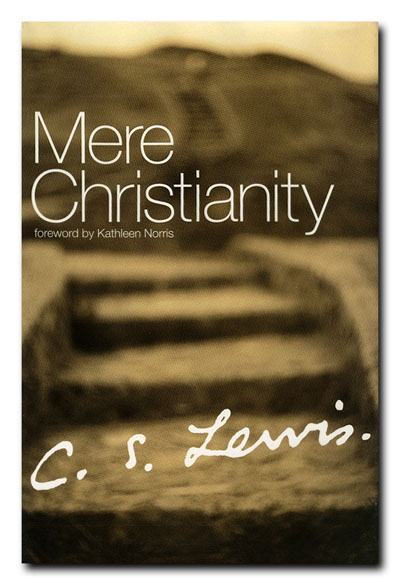
This book, published in the year 1952, was a compilation of talks delivered by the Christian academic and apologist Clive Staples Lewis, on the BBC between 1942 and 1944. It has since turned out to be one of the most widely read books on Christianity and Christian apologetics ever written.
The title, “Mere Christianity” may seem a bit unfitting for this work, because it has some seemingly unusual reasoning style for a Christian book. But that’s probably an ignorant assessment. It is indeed about “mere Christianity”; Christianity in the simplicity of its original and practical form. The title was in fact adopted from G.K. Chesterton, who influenced C.S. Lewis to some extent.
Lewis considered it necessary to begin an explanation of the Christian faith by establishing a basis for God, who all Christians believe in, and worship. In five chapters, he gradually builds his case. From initially pointing out in chapter one (“The Law of Human Nature”) that humans seem to have a sense of “right and wrong” by which they judge actions of theirs or of others, he proceeds to deal with objections to the idea of morality being universal; he agrees that cultural differences exist on this matter but points out that there are universally held moral principles nevertheless, which are core to the moral system of any culture. He suggests that the reason why there is a sense of morality where (in an otherwise purely materialist world) we could easily make ourselves happy by saying that there’s no such thing, is that it is innate. And what’s more, it isn’t really material. A Mind, which bestows morality (and meaning) must have put it there. A mind greater than man’s, greater than material. Lord over mind and material. So, Lewis says, we have cause to be uneasy. This is why: we agree to moral standards. We fail at keeping them. And a consciousness greater than us appears to be watching, and taking notes- judging our right and wrong. And yes, we’re failing.
Book two, titled “What Christians Believe”, begins where book one left off. Lewis presents rival conceptions of God, and rejects pantheism for its inability to account for his observations on morality; and dualism, for its apparent claim that evil, like good, has no beginning and no end, and are eternally at war. He wonders whether it would not then be up to the observer of this cosmic struggle to choose the one he thinks to be “right”- in which case, the question arises: by what standard then, is right or wrong being identified as so?
But he also criticizes the idea that God should have made Himself more obvious, by an “invasion”, instead of the humble coming (among other “concealed apparitions”) of Christ as man. He suggests that it suits man better. For if God were to truly turn up in all His power and majesty, it would be for one thing only: to judge. He will one day. But He has shown mercy by coming to us in the humble and accessible way. For this, we should be grateful.
In Book three, (Christian Behaviour), Lewis begins to deal with Christian morality. He approaches this matter by looking at the “Christian Virtues”- first, the Cardinal virtues: prudence, temperance, justice and fortitude. He explains these in a truly illuminating way, dispelling popular misconceptions about them. He goes on to talk about social morality, and the failure of psychoanalytic techniques to bring about a well rounded conception of morality by any individual. Then he defends the virtue of Chastity and rebuffs the claim that modernist craze for unhinged sexual liberalism is the result of being “sexually starved”. He says the growing interest in loose sexuality has only begotten more sex craze, not less. It has led to a proliferation, not a satisfaction or an appeasement. The Christian model for marriage is also extolled. It is not just about feeling that one is in love; it is also about justice being shown in your pledge to your better half to remain unseparated from him/her “till death do us part”. God, the children, and the human witnesses to this contract are also considered in this.
Forgiveness, Charity, Hope and Faith are treated too. But especially noteworthy is Lewis’ exposition on pride, which he (rightly) calls “the great sin”. He affirms that pride, which thrives upon and fosters self-centeredness, is a rebellion against God as the One, the LORD. It is widely spoken against, but seldom admitted. And it is perhaps the most common of all sins. In fact, it could be said that there is a trace of pride behind every sinful act of man.
The fourth (and final) book explains the “becoming” of Christianity, the making of a “new species”, not merely “nice people”. He drives his point home with a ringing truth which he states: that God calls us not to give Him the things we have. Not even all of them. He wants us. Our selves. And you search for “yourself”, you will find only emptiness and disappointment in the end. We will not be satisfied. We will only be in despair. But if you seek Christ, you will find him: the joy of sacrifice, love, peace beyond all understanding, satisfaction in devotion to God, and every other thing that comes with dying to ourselves and letting our lives be Christ’s and Christ’s alone.
While a few points in this book do not appear to the trained mind to have been clearly made or argued, such apparent deficiencies do not in any way diminish the great contribution that this book has made. It has changed many lives, helped a lot of people on the path to knowing God, and made clear numerous concepts in Christianity which many, including this reviewer, initially struggled to understand.
I recommend this book to those seeking to understand the Christian faith. And to those who are Christians, and want an even clearer understanding of what they believe.