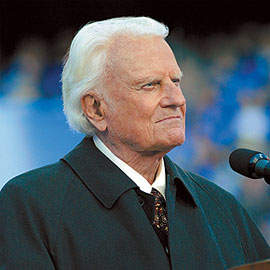
For six decades, the tall sturdy frame of evangelist Billy Graham graced the TV screens of living rooms the world over. His unmistakable voice boomed over the radio in cars, tool sheds and stores, and left lasting auditory memories with most who listened. The message he had was almost always the same: the Gospel, in its simplest possible form, delivered with decipherable honesty and earnest. It was this plainness in speaking, as well as in his living, that endeared him to millions across the planet.
Early Years: From Dairy Farm to Bible School
Billy- or William Franklin Graham Jr, as his parents had christened him -was born in 1918, to a dairy farming family in Charlotte, North Carolina. It was the year in which the first world war ended- but that seemed a somewhat faint and far off reality from the quiet town which the Grahams called home. Billy’s later life was spent lacing the air waves with his charming Carolinas accent; perhaps God left nothing to chance when putting together the aspects of this exceptional evangelist’s personality. Apparently not even his speech.
Graham’s parents were practising Presbyterians (his mother moreso), who attended the local denominational church with their children on Sundays. They did have regular family devotions as well; but it’s not clear that young Billy was initially stirred by any of the early exposure he had to the Christian message.
It was at a revivalist meeting that Billy Graham got converted. The year was 1934. Mordecai Ham, a travelling baptist preacher, had come into Charlotte and was holding revivalist meetings. Billy was invited to attend by one of his father’s workers, and it was there that he made the formal decision to commit his life to God. Commentators point out that his wasn’t the storybook ‘bad boy turning to Christ’ event; master Graham was no mischievous fella. But he was gripped enough by Ham’s preaching about sin and salvation, to make a life altering decision that day.
Two years later, Billy completed high school. He hadn’t been an exceptional student by any stretch of the imagination; at one point, a teacher of his had warned that he might not make it out of school. Nevertheless, he scaled this hurdle, and went on to study Theology at the Bob Jones College in Tennessee. It’s safe to say that his issues at school probably came down to an apparent nonchalance about school work on his part. After all, he was in fact a bookish lad in his own right- it’s said that he sometimes got so immersed in his reading that he seemed to grow oblivious of his own self.
The Making of an Unshackled Travelling Evangelist
Graham’s time at Bob Jones wasn’t the happiest in his life. He found the rules too stringent, and the doctrine taught and practised there rather shackling (the institution’s authorities were so strict with their students, they screened whatever correspondences came in to them, and what they sent out. Feeling stifled of real spiritual freedom, he transferred to the more relaxed (but nonetheless conservative) Florida Bible School.
His trouble with the Bob Jones College hints at what was a severely polarized church at the time. The liberal Christians, wary of the supposed threat posed by the advances in science and the secularization of society, had retreated to an understanding of the Bible as not inerrant, while racing out of their pews to embrace the ‘progressive’ world beyond their church walls. Conservative Protestants were doing the exact opposite: they stared in defiance at the liberalizing society, railed against what they believed was America’s multiplying evils, and affirmed a straight jacket literalism in their exegesis of the Bible.
But Billy was learning (perhaps not very consciously) to thread a reasonable middle path. In later years, he would come under fire from both sides of the divide: liberals would label his preaching “too simple,” and conservatives would condemn him for being unnecessarily cozy with liberal ideals.
After completing his studies at the Florida Bible School in 1939, Graham enrolled at Wheaton College, hoping to get grounded in the ministerial work he was looking to begin. There, he met Ruth McCue Bell, the grand daughter of a missionary, who would later become his wife. And it was in this period that he preached his first sermon (in a small baptist church), at the behest of an academic dean at Wheaton.
In the decade that followed, Graham briefly pastored a church, worked with a Christian youth organization, and oversaw an alliance of Christian schools. It was at the end of this time that he turned towards itinerant evangelism.
The Start of a Remarkable Ministry
Chroniclers of Graham’s long life point to his visit to California in the early 1950s as the time in which he began to grow in prominence. He had been invited by a Christian organization, Christ for Greater Los Angeles, to preach in their city. When he did begin to deliver sermons there, his simple, earnest message drew people to his meetings. Secular historians say it was down to his charisma; many who were in the crowds insist that it was more the compelling nature of his sermons that brought the masses to the large meeting tents.
Some have said that his popularity was helped by local media’s favourable coverage of his crusades, which was in turn the result of his having admirers in the media circles, and his vocal opposition to communism. In a world increasingly torn between Communism (and its associations with militant atheism) and capitalism (cast as allowing for the freedom of religious observances), Graham’s condemnation of the former was sure to endear him to the US’s anti-communist elite and common people.
While it’s reasonable to view his preaching within the historical context in which it took place, we would be rewriting history if we gave it credit for Graham’s success at bringing people to Christ. The single most important factor in the success of his ministry was his dedication to the ‘total Gospel’, and its effectiveness, shown in the transformed lives of those who embraced the message. Besides this, it’s hard to explain how an increasingly skeptical Western society (one in which ‘theologians’ proclaimed that God was dead) would turn out millions of people to hear a preacher repeat the old fashioned gospel?
Going Global
In time, the crowds at the meetings grew so large, and the work of organizing such gatherings became so complex, that Graham and his friends decided to incorporate the ministry. They named it the Billy Graham Evangelistic Association (BGEA).
With wider media coverage and a more sophisticated media structure, Graham was able to reach other parts of the United States. Millions more were ministered to, and the conversions numbered in the hundreds of thousands. By 1952, the BGEA made its first landing in the United Kingdom.
It was in England, where the state of religion was represented by a staunchly liberal church, that Billy Graham’s international evangelism truly began. Many thought he would not be nearly as well received there; the Brits were supposed to be more measured, prim and proper, not given to the outward expression of emotions and overly simplistic teachings that characterized the American evangelist’s crusades. But they were wrong. After initial opposition by officials within the Church of England, Graham did finally set foot in the UK. And the crowds were just as big (and emotive) as the ones in the United States.
By the time he delivered his final sermon in 2005, Billy Graham had preached to over 215 million people across the world. He was a known bearer of the gospel, recognized for the way in which he was able to persuade his audiences with it. Between his going global and retiring in the mid 2000s, he had touched every inhabited continent of the world with his message. Thanks to his efforts, many accepted Jesus as their saviour.
An Uncommon Man’s Legacy
Graham’s influence stretched over the entire spectrum of human endevour. He was friends with (and counselor to) heads of state, from Dwight Eisenhower to George W. Bush. It’s reported that he had a good relationship with the Queen of England, Elizabeth II. He was also known to have spoken out against dehumanizing the underprivileged, including Black South Africans who were oppressed under that country’s White minority rule for the greater part of the 20th century.
It’s hard to exaggerate Graham’s impact on the Church’s approach to evangelism. His organized, media savvy organization helped take the Gospel farther than most had managed up until his time. His preaching, which emphasized mere (basic) Christianity, became a template for others who came after him.
Billy Graham passed on in February 2018. The world- or much of it -eulogized him. Countless words were spoken of his voice and looks, but also of his humility, faith and love. It’s certain that the man himself would have wanted to be remembered simply as a servant of Jesus, who put the resources of the age to good use in making the truth of God known to all people.
Ikenna Nwachukwu ©2019