Prophet Suddenly 3 poster

PROPHET SUDDENLY 3 – The Music Minister – A REVIEW

EXECUTIVE PRODUCERS: Ohis Ojeikere, Anwuli Ojeikere
DIRECTOR: Ohis Ojeikere
MAJOR CAST: Ohis Ojeikere, Laurel Olu-Egbor, Lawrence Oyor, Apostle Arome Osayi, Bishop John C.W., Pastor Gideon Mba, Anwuli Ojeikere, Nwankwo Paul Chukwudi

LOCATION: Nigeria, Kenya, USA
YEAR: 2025

REVIEWER: IFIOKABASI OKOP

NB: This review contains spoilers.

This third installment in the Prophet Suddenly – The Music Minister series follows the rise and tragic spiral of a gospel music minister whose greed, lust, carelessness, and disobedience to God eventually lead to his downfall.

The film arrives amid recent conversations around gospel music ministers charging large sums to minister in churches. While some condemn the practice outright, others argue that these ministers serve in the temple and deserve their wages. Yet others believe that only God should determine whether a minister charges or not. 

Although Prophet Suddenly 3 was shot before these debates became widespread (especially with gospel artists now suing their record labels), it is a timely contribution to the conversation. Importantly, the movie does not answer the question: Should a gospel minister charge to minister at churches? Instead, it explores the deeper issue – the intent behind such decisions.

Minister James, played by Muyiwa Ohis Ojeikere, is undoubtedly anointed, but his fame feeds his greed. In his very first scene, he refuses to minister at a church simply because they hadn’t completed payment of his honorarium.

What an introduction!

He ditches that church with cold indifference and heads to a bigger church where the pastor gives him a huge honorarium. If gospel ministers act like this in real life (which I sincerely pray they don’t), the body of Christ has a serious crisis.

On the surface, Minister James’ story is a cautionary tale of what happens when a man of God drifts into carnality. But on a deeper level, it depicts the spiritual warfare that rages behind the scenes for the soul of every servant of God. You may be doing great exploits for the kingdom, but the devil is always strategising, and if you live in sin, you are already within his grasp.

There are many lessons to take from this film, but the most important one for me is this: BE ACCOUNTABLE TO YOUR SPIRITUAL MENTOR.

If Minister James had walked in obedience, humility, and transparency with his pastor, he would not have met his Waterloo. Yet, I appreciated that his path back to God was done the right way. Many live in sin and think that simply confessing to God is enough. NO! James 5: 13–15 explains the power of confessing your faults to a righteous man whose prayer is powerful and effective. Minister James did just that. Apostle Arome Osayi’s character prayed for him, and the bondage was broken. If he had not humbled himself, confessed, and sought prayer, he would still be in chains.

MUSINGS

What I Loved

The Soundtrack & Sound Design
For a film centered on a gospel music minister, Prophet Suddenly 3 did well. The original soundtrack and sound effects were immersive, pulling the viewer into the emotion of every scene.

The Locations
Normally, I roll my eyes when Nollywood movies span 3 to 4 countries because it feels unnecessary especially if it adds nothing to the story. But here, it worked. Minister James’s global trips reinforced his obsession with fame and money. He had to fly to Kenya to show the depth of his greed, and his collaboration with a U.S. label made his global ambition believable.

Lawrence Oyor’s Performance
He can act—no debate. I enjoyed watching him in the last season of Abattoir, and in Prophet Suddenly 3, he delivered again. His portrayal of an earnest fanboy was both hilarious and oddly heartbreaking.

The Acting
The cast size grew significantly in this installment, and everyone came prepared. Even the extras were performing like their rent was due. Comic timing, especially from Minister James’ manager (Nwankwo Paul Chukwudi), was impeccable. By the way, I indeed caught Damilola Mike-Bamiloye in a tiny cameo.

The Cameos
Apostle Arome Osayi’s presence is a given. I loved that his character continued to serve as a moral compass for Minister James. The other pastors, despite limited screen time, delivered convincingly. Rev. Dinna Osayi’s cameo was also a pleasant surprise. 

Bishop Baazu
Played by Bishop John C.W., this character was deeply unsettling. He played the two-faced bishop so well that his evil stares were chilling.


WHAT COULD’VE BEEN BETTER

Character backstory
How did a young man raised under a godly pastor fall so far into greed and lust? Was it only the manipulation of Miokukusheshe (Laurel Olu-Egbor) that caused this? A clearer depiction of negative influences (perhaps another minister) would have made the descent more believable.

More Music, Please
For a movie about a gospel singer, we got a few ministrations. That short scene where he ministered “Holy, Holy, Holy” was beautiful. More songs like that would have enriched the film.

The Ending Was Too Abrupt
I needed closure. What happened to his band? Did he confess, repent, and reconcile with them? What about his fiancée (Anwuli Ojeikere)? Did she stay, or move on? The epilogue was thought-provoking, but I still wish these side stories had been resolved more clearly.


FINAL THOUGHTS

Prophet Suddenly 3The Music Minister taught me a lot and reminded me of lessons I had forgotten. It took on a heavy theme, exposed uncomfortable truths, and pointed us toward restoration through humility and accountability. It’s spiritually intense and socially relevant. If you haven’t watched it yet, what exactly are you waiting for?

Watch it here.

What are you seeking?

When I was much younger, my mom shared a brilliant analogy with me and my siblings. She said God is like an ocean; if you came to Him with a cup, you would get a cup full. If you came to him with a massive drum, you would get a drum full. If you came with a water truck, as huge as it is, you would still get it filled. The point is, that you get what you ask for. In essence, when we are dissatisfied with our results, an excellent place to review would be what we are asking for. Many times, our expectations are truck-sized, but we approach God with cups and wonder why we never feel satisfied. The ocean is clearly sufficient to fill any vessel, yet every person gets the amount of water they make space for, regardless of their intention.

Many times, our expectations are truck-sized, but we approach God with cups and wonder why we never feel satisfied.

An iconic part of Jesus’ famous Sermon on the Mount reads thus:

“Ask, and it will be given to you; seek, and you will find; knock, and it will be opened to you. For everyone who asks receives, and he who seeks finds, and to him who knocks, it will be opened.
Matthew 7:7-8 (NKJV)

In reading this, it is easy to focus on the instruction rather than the implication of the promise. Especially in the 8th verse, Jesus makes a definitive statement that when we do our part, we are guaranteed an answer: The one who asks will receive, the one who seeks will find, and the one who knocks will be opened unto. In a sense, Jesus is saying that in cases where your results don’t satisfy, God is not the person to look at. You should review what you are asking for.

In the following verses, Jesus challenged his audience, asking if they were better fathers than God. His argument was, “If you would not give your children what they did not request, why do you think God will operate like that?” This is also the main proposition of this article: with God, when we ask, seek, and knock, we will receive, find, and be opened to, but we can remain unsatisfied with the result if the request is not right.

Among the three actions Jesus listed – ask, seek, and knock – I find seeking to be the easiest way to make this point, so for this article, I will place a specific emphasis on seeking even though it applies to all three. Jesus promises us that whatever we seek, we will find. Therefore, more often than not, our dissatisfaction comes from what we find. The flipside of Jesus’ promise is that you won’t find what you are not seeking. Essentially, our only hope of finding the right thing is to make sure that we are seeking the right thing. We must critique our seeking to ensure we find the things that are truly valuable to us.

Seeking in Nigerian colloquial English is “looking for something”. This establishes that the act comes loaded with two presumptions: there is an absence of something, and that thing has a value that necessitates the search. Therefore, to truly ascertain that we are seeking the right thing, we should define what we lack and the value that is inherent in the thing sought. For example, if I am seeking food, the presumptions that validate my endeavour are that I am hungry and, secondly, that the food I am after can satisfy my hunger. If I were seeking diamonds when dealing with a hunger problem, I would be setting myself up for gross disappointment.

Essentially, our only hope of finding the right thing is to make sure that we are seeking the right thing. We must critique our seeking to ensure we find the things that are truly valuable to us.

These two presumptions further establish how we can establish what we are seeking. This is necessary because oftentimes we claim to be seeking things that we are clearly not going after, and then we are genuinely shocked at what we find. To avoid this happening to you, make sure to use these presumptions to judge yourself. The first thing to ask is, “What do I lack?” The answer might seem too obvious and overwhelming, as human wants are insatiable; therefore, human lack is constant.

Our limited nature places us in a perpetual state of lack, but we do not seek after everything we lack. The second factor of seeking – value that necessitates the search – helps reveal where we invest our limited efforts. Anything that is valuable enough to make you move defines what you are seeking. Simply put, your lack may be evident and varied, but the things that you value are what eventually lead you into the adventure of seeking.

Many Christians can testify that their search for Jesus started because there was a significant lack in their lives. Many have come to the foot of the cross because of a lack of good health, peace of mind, prosperity, answers, and identity, among other needs. Fortunately, like the woman with an issue of blood in Luke 8:43–48, after trying everything else, we end up trying Jesus.

So, we identify our lack and cast our eyes on the capacity of Jesus, so we go seeking. Just like that woman, many have testified that what they could not get anywhere else, they found in Jesus. These types of stories usually bring tears of joy to our eyes and put big smiles on our faces. The problem with this is that oftentimes, the lack remains in some other part of their lives, or in some cases, some people actually don’t get what they want, and that can be hard to make sense of. Ideally, this should raise an important query:

Is Jesus incapable of meeting our needs, or are we seeking Jesus for something less than what He promises?

When we look at our anchor scripture from the gospel of Luke, it reads thus:

“So I say to you, ask, and it will be given to you; seek, and you will find; knock, and it will be opened to you. For everyone who asks receives, and he who seeks finds, and to him who knocks, it will be opened. If a son asks for bread from any father among you, will he give him a stone? Or if he asks for a fish, will he give him a serpent instead of a fish? Or if he asks for an egg, will he offer him a scorpion? If you then, being evil, know how to give good gifts to your children, how much more will your heavenly Father give the Holy Spirit to those who ask Him!”
Luke 11:9–13 (NKJV)

In Luke’s account, we see that when Jesus was talking about how we can get anything from God the Father, He directly stated that the good thing we should seek from God is the Holy Spirit. This implies that while God would give us many things, His greatest desire is for us to have the Holy Spirit. The emphasis placed on the Holy Spirit can be understood by looking at the following scriptures:

But he who is joined to the Lord is one Spirit with Him.”
1 Corinthians 6:17 (NKJV)

For what man knows the things of a man except the spirit of the man which is in him? Even so, no one knows the things of God except the Spirit of God. Now we have received, not the spirit of the world, but the Spirit who is from God, that we might know the things that have been freely given to us by God.”
1 Corinthians 2:11–12 (NKJV)

These verses make a very important claim: to have the Spirit of God is to share a level of intimacy with God that is unattainable by any other means. It is to know God intimately and, consequently, to be known by God. Hence, in Luke, Jesus was essentially saying the best thing you can ask from God is to share His Spirit, to be intimate with Him, to know Him, and to be known by Him.

Everyone who comes into the Christian Faith should essentially be seeking this relationship of spiritual oneness with God, galvanised through the person and sacrifice of Jesus.

You see, at the very core of what Christianity is, we find a relationship between the Creator and His creation. This relationship (and all its sides) is essentially the focus of the Bible. By the standards we have previously set, we can make the claim that Christianity is focused on this relationship because man’s greatest lack is a relationship with His Creator, and the only possible way of getting that back is through Jesus. During His time on earth, Jesus repeatedly uttered the command, “Follow Me”. We can see that He does this because He knows man’s greatest need is not for the things we are focused on; rather, it is Him, a physical representative of the Godhead, that should be sought after. He presents Himself as what is lacking in this world (John 8:12) and as valuable enough to lose everything else in a bid to seek (Luke 9:23).


Therefore, everyone who comes into the Christian Faith should essentially be seeking this relationship of spiritual oneness with God, galvanised through the person and sacrifice of Jesus. This implies that a Christian is a person who recognises the lack of God in their life and seeks Jesus as a worthy answer to satisfy that lack. The seeker considers a relationship with God to be of infinite value but also recognises that that relationship is only possible through the sacrifice of Jesus and expressed through living like Jesus. So, the seeker maintains an intentional desire to know Jesus and live like Him. This does not mean the one who seeks Jesus does not have normal human needs; it just means his priority places the knowledge of Jesus as foremost and of utmost worth.

It is important to note that the depth of need and/or the value of what is sought after can be discerned by paying close attention to how the seeker goes about seeking. The intensity, care, and support required to find something can tell a lot about what is being sought after and the value that it holds. For Christians, this is so true because the way we seek shows whether we understand the value of what we are seeking or if we are even seeking the right things. The seeker who prioritises their relationship with God understands two things: it requires the help of the Holy Spirit, and it is not a quick fix. This should help you understand that your seeking as a Christian may be flawed if you think it can be entirely achieved in your strength and/or if your fulfilment can be achieved with one quick fix.

This truth can be derived from Jesus’ iconic command, “Follow me”. The first word implies that this is not quick. In fact, it suggests a walk without an end because the one who follows just keeps on moving until the other stops. The second word in the command is “me.” This squarely places the responsibility for how things go on Jesus’ shoulders. Simply put, Jesus tells us that seeking Him is a long process that He alone can sponsor. The one who seeks Jesus settles in for the long ride and has no trust in human effort. This is where the Holy Spirit mentioned in Luke comes in. Jesus admonishes us to desire the Holy Spirit, as He holds the power to sponsor our seeking.

The seeker who prioritises their relationship with God understands two things: it requires the help of the Holy Spirit, and it is not a quick fix.

“These things I have spoken to you while being present with you. But the Helper, the Holy Spirit, whom the Father will send in My name, He will teach you all things, and bring to your remembrance all things that I said to you.”
John 14:25–26 (NKJV)

Therefore, seeking Jesus looks a lot like depending on the Holy Spirit. In practical terms, it is an incessant desire to know Jesus and a complete dependence on the Holy Spirit to have that desire fulfilled. So, the seeker engages in Bible Study but does so with a desire to know Jesus and prays earnestly for the Holy Spirit to facilitate that process. The seeker prays as a means of building and enjoying a relationship with God, but completely trusts the Holy Spirit to empower that process.

With this established, our seeking enterprise is only fully maximised when we set our sights on Jesus and completely depend on the Holy Spirit. Unfortunately, this is not a given among Christians. Just like in the days when Jesus was on earth, many seek after what He can do for them rather than who He is and the power He desires to give us. These Christians have a hard time making sense of their lives because they are standing in front of an ocean and have only cups of experience to show for it.

Jesus answered them and said, “Most assuredly, I say to you, you seek Me, not because you saw the signs, but because you ate of the loaves and were filled. Do not labour for the food which perishes, but for the food which endures to everlasting life, which the Son of Man will give you, because God the Father has set His seal on Him.”
John 6:26–27 (NKJV)

To seek Jesus for anything less than Him through the Holy Spirit, which is the seal of our salvation, is to cut yourself short of an infinite blessing. In Philippians 3, Paul declared with ultimate certainty that there is nothing we need more and nothing more worthy of our time than knowing Jesus. You might temporarily meet your immediate needs by asking God for one thing or another, but if you are seeking just that, you will eventually be frustrated. It has to be Jesus we seek. Gratefully, Jesus has already promised us that He is not far from us, and if we can set our minds to seek Him, He will surely be found. So if you feel like you have not sought him truly, there is still hope for you. Like the prodigal son in Luke 15:11–24, you can turn around now and seek the right thing, or, better put, the right one.

Therefore, when we orient ourselves to seek Him not for what He can do but for Himself, we open the door of our hearts to divine intimacy.

To conclude, I want to show you an endearing picture from the last book of the Bible:

“Behold, I stand at the door and knock. If anyone hears My voice and opens the door, I will come in to him and dine with him, and he with Me.”
Revelations 3:20 (NKJV)

Throughout this article, the rhetoric has been that we are seeking after God. In certain applications, this works, but I think it is beautiful that the Bible clearly establishes that we are not seeking a passive God who grants us access to do a good job. Rather, our Father seeks us as intensely as He admonishes us to seek Him. He comes into our lives not seeking what we can do for Him but for the fullness of who we are. Therefore, when we orient ourselves to seek Him not for what He can do but for Himself, we open the door of our hearts to divine intimacy. There are not enough words in the world to describe the beauty of that intimacy. It is so rapturous that men died for it, and God gave His Son, Jesus, for it. If you seek it, if you seek after Him, you will not be disappointed.

EZEONYEKA GODSWILL

WHAT BEGAN AS A DILEMMA

Part II

Usually, I have everything in my life fixed including how I want to live and move and have my being. I do not need further help except for this one: I am in a dilemma—
Running marathon on a steep path and finishing adorned; or sprinting along a smooth lane only to come out alive.

But why is it that in this life of mine, I always almost have just two options?

Well I do not need any help from this man standing before me, who hails from nowhere like Melchizedek—This man who promises me a better portrait of myself.

Then a song begins to play from his chancel lamp. No wonder it looks just like a home theatre. I watch the orange flourescence dance like disco light as the song plays:

I want God’s way to be my way as I journey here below for there is no other highway that a child of God should go.Though the road be steep and rough, if he leads me it’s enough, I want God’s way to be my way everyday.

The voice is sweet but the words are quietening my nerves. I am uneasy about the ease I am experiencing. I am not used to calmness because in my philosophy, a man must be up and doing or else how does he prove to be up to task? This is why most times, it’s either I’m up or I’m doing.

The words of the song are taming my soul further into stillness. They are like tranquilizer, vanquishing the spasmodic discomforts in my gut. My whole body is heavy yet light, and it seems I can’t feel anything anymore, as if somebody else, a presence, is living on my behalf.


I find my face turned toward him, my gaze fixed on him. I startle at what I see on his face: Words are displayed on his forehead like a computer screen:

Better is it to (stand) as a doorkeeper in thy tent than to dwell(at ease) in the tent of the wicked.


I am wondering what the tent of the wicked is and before I can take the next breath, he has answered me as though he is hearing my thought.

The tent of the wicked pitches in the heart of a man who chooses ease at the expense of God’s way.

It is as Sodom to Lot, a place that a man appoints for himself because of splendour and comfort without seeking to know if it pleases his maker. Many men opt for their own choice without caring whether it is the portion allotted to them from above, just in a bid to escape the seemingly perilous pathway to glory.

To dwell in the tent of the wicked is to be like the servant who hid his master’s talent under the ground, damning the consequence of an unfulfilled destiny, thinking his master is a hard man subjecting him to a rigorous and unattractive lot.

You see, I make beautiful portraits with both dark hues and bright colours, with both broken lines and straight lines. I need them all combined to create my pleasure and make art of men.

My perfect will is a blend of the good and what you term the bad. In the end, I bring light out of darkness and turn crooked paths straight, but first there must be pain before gain, suffering before satisfaction, peril before pleasure.

As lucid as the message of a simple poem, everything is now making meaning to me. First, the song, then his words. What began as a dilemma is diving out of the deep.

Suddenly, I am no longer in a dilemma! I am no longer in a dilemma!

My heart melts into brokenness. The tears are already forming bubbles on my cheeks. Wobbling, I fall into his bosom. This time around, I am not up and doing, I am down and done. I can no longer lift up my face before him and my tremulous hands can no longer hold the pencil.

The man is now sitting on a big throne and not on my chair, he’s making my portrait on a mighty wall erected before him. All of this is taking place in a room where an altar is burning and not in my art gallery.

In the portrait that he’s making, I begin with plenty dark hues but I am gradually evolving into bright colours. Also, there are many broken lines but the straight lines are becoming superimposed on them such that the broken lines are hardly noticeable. He is still working on the art while I am set to begin my marathon race upon the steep path.

It is the last week of the year but what began as a dilemma this morning has transpired into the divulgence of a mystery capable of ministering strength to me every morning.

One day, soon, when I finish this race, which I’ve embraced with hope and joy, I hope to change the inscription on the entrance of my art gallery to:
Out of Zion, the perfection of beauty, God has shined out.

Ayooluwa Olasupo (Imisi)

WHAT BEGAN AS A DILEMMA

Part I

It is the last week of the year and I am in a dilemma—

Running marathon on a steep path and finishing adorned; or sprinting along a smooth lane only to come out alive. But why is it that in this life of mine, I usually have only two options?

It doesn’t seem I’ve got a way out of this dilemma yet, so I stroll into my art gallery. I have not been there in a while. I draw the curtains to allow light rays fall into the room, then I pull out a chair and start to sketch a portrait of myself— the kind I have longed to possess for ages.

I do not like to see dark hues in a work so in that drawing, I am appearing bright and beautiful and my face is beaming with all the colours of the rainbow.

I do not like broken lines too, so with my eraser, I clean the broken lines where a pair of glasses sits on my nose, carefully converting them all into perfect lines with my ruler.

My canvas will soon be wearing that perfect portrait of me.

I look at this work of art again with great enthusiasm; it is almost complete. I feel so satisfied that I do not know when my lips part to drip smiles from the corners of my mouth.

Then a man approaches me whom I do not know. He’s old enough to be my father but his own face glows. He doesn’t knock nor turn the knob and I can’t fathom which way he entered through.

Apart from the chancel lamp in his hand that gives off warm light and resembles a mini home theatre, there’s something about him that surpasses my understanding and even his stance sends ounces of awe down my spine.

I am admiring him until he says I should let him hold my tools, let him have my canvas, let him own this art gallery and he’ll make a better portrait of me. I giggle. What is better than my own “perfect”? My own “perfect”.

I am angered. I am nervous. I can feel my intestines twisting, hear the gush of acid pouring into my chest from my stomach at the sound of his request. It seems I can even hear as my valves are opening to pump blood out of my heart because both of my legs are now becoming warm.

But, there is something about him that makes me have a rethink about refusing to give him chance. I look at him again with uncertainty. He doesn’t look like someone who can violate my work yet I’m afraid.

I’m afraid he might alter, alter this piece in which I am almost becoming a perfect portrait of my dream self….

Ayooluwa Olasupo (Imisi)

The Chosen Review: Shabbat

How would you feel if the President of a country, whom you hold in high esteem pays you a visit uninvited? Especially when he passes by other houses and decides on your unspectacular house?

Sounds unbelievable?

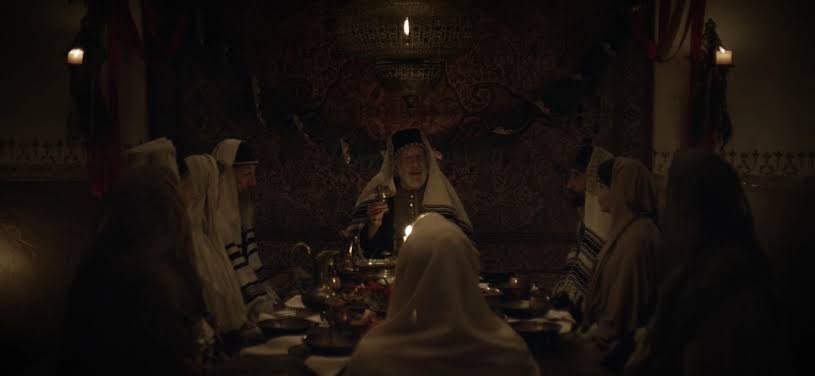
That is exactly how Mary must have felt in Episode 2 of The Chosen when the doctor who healed her of her infirmity without collecting a dime showed up at her doorsteps for Sabbath. More important was the fact that she did not invite him, yet, He found her.

I want such an August visitor, who wouldn’t?


But just before Sabbath, we witness the events of the day in the lives of Mary, Nicodemus, Simeon Peter and Matthew. We observe as Matthew display a matchless level of courage before the Praetor of Judea, Quintus, from whom he went to confirm if Simon Peter and his brother’s taxes had indeed been waived by the Roman Officer as alleged by Peter in exchange for a job for the officer.

Read The Chosen’s S1 Ep1 Review

Matthew learnt that their taxes had been waived for a job which required Peter to spy on his brethren and bring names of those who worked on Sabbath and were tax evaders. An act considered as betrayal and greatly disapproved by his brother, Andrew.

In the same episode, Nicodemus to his uttermost dismay got information that Mary Magdalene upon whom he had earlier performed religious rites to deliver her from demonic possession, though unsuccessful, had been miraculously healed, a task which he had earlier deemed humanly impossible. He embarks on a quest to find out how this came to be.

They all seemed to have had a busy day but what was much more interesting about these characters was how they celebrated Sabbath.

One had so much friends all around for the events. Isn’t that what we all want? Another chose money above his family, the one who wanted to spend time with his family was not wanted by them while Mary had an august visitor! From all these, what can we learn?


So what makes Sabbath so different from every other day and how did these people prepare towards it?

How should we celebrate what we consider to be the “day of rest” in our society? Episode 2 offers us the requisite answers to these.

Download The Chosen App here to watch the series for free.

Watch Season One’s trailer here.

God trusts you!

Often when we teach trust to believers, we encourage them to trust God but what if the right way to look at it is from the angle that God trusts us – Me.

Because…

The act of loving itself is impossible without a measure of trust.

When I understand that God initiated the love relationship between Him and I, I also understand that it must mean He trusts me.

Throughout the Bible we see this concept proven over and over in every relationship God has with a man. Against all odds and through generations of unfaithfulness and inherent flaws, God continues to put his love on us, risking his trust being broken and trusting the good he saw in us when he first created our kind at Eden.

I’m a Creative so I can relate to the love a creator has for his/her creation. No matter how imperfect, we believe there’s good in every creation at the very least. At worst we believe it can be better and sometimes we spend entire lifetimes trying to perfect our creation.

God is a Creative.

So every time I fear or worry, he’s still there trusting me through the process and it’s this unrelenting trust he has in me that eventually saves me. Because he trusts me, he keeps coming for me, keeps teaching me, allows the experiences I need to learn from happen, he keeps healing me…

He has enough faith for us both
He doesn’t ask for what he hasn’t given

So when he asks for my trust and my faith and my love, it’s because he has given them to me ahead.
It doesn’t matter if it’s the one-millionth time I fail, or worry or fear or fret…
He’s there. He trusts me to get it right. He knows I can.
Be good. Be better. Do better. Do more.
He trusts me to trust him because he wants to partner with me to pull madht stunts on earth.

Wow.

I mean, when we see it this way, suddenly trusting God becomes easier and doable. It just makes sense.

– St. Davnique
(c) 2021